Our Projects
VRWJPO invests in capital improvement projects that protect or improve water resources and/or are identified in the Watershed Plan. Projects are intended to address impairments such as phosphorus, total suspended solids (TSS), turbidity, nitrates, aquatic invasive species (AIS), and other issues as they arise.
Many of our large-scale water resource projects are funded by grants through the Clean Water, Land, and Legacy Amendment, approved by Minnesota voters in 2008 and planned to sunset in 2034. The value of these grants to VRWJPO’s successful water quality improvements cannot be overstated.
All completed capital improvement projects installed with VRWJPO funds are identified on an interactive map with yellow and red stars.
Recent Projects
Launch Park South Creek Wetland Restoration
The South Creek of the Vermillion River begins east of Lake Marion in the City of Lakeville, where it flows south and east until it meets the Vermillion River Mainstem in Farmington. Much of the creek carries a trout stream designation from the Minnesota Department of Natural Resources, meaning it has special water quality requirements to maintain its status as a coldwater fishery. Making its way through an industrial area of Lakeville, the creek is listed as impaired by the Minnesota Pollution Control Agency due to high total suspended solids (TSS) and poor aquatic habitat.
In 2023, the City of Lakeville acquired a property previously in agricultural production within the Launch Park Development, an adjacent road construction area relating to the 220th Street and Galway Lane Extension. The property was acquired as the City identified it as an opportunity to convert it from agriculture to a restored wetland in an effort to reduce TSS loading, attenuate runoff volume, and enhance aquatic life in South Creek. A tributary to South Creek runs directly through this wetland.
The VRWJPO, Dakota County, and City partnered to cost-share completion of the South Creek Wetland Restoration in fall 2025. The project will result in the enhancement of 6.18 acres of Type 1 wetland and the creation of 1.69 acres of Type 2 wetland.
Firelight Way Total Suspended Solids (TSS) Reduction
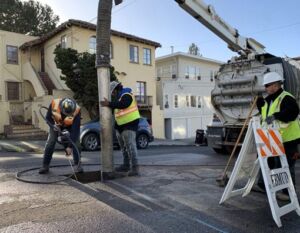
During the 2024 Watershed-Based Implementation Funding (WBIF) planning process, the VRWJPO, in partnership with the City of Lakeville, proposed installing a hydrodynamic separator (HDS) on Firelight Way east of Greenridge Park to reduce sediment transport in stormwater runoff from this area. Since the runoff flows to North Creek and eventually the Vermillion River, treatment can help address impairments in both water bodies. An HDS is a stormwater device that uses cyclonic forces to remove pollutants in stormwater runoff, namely sediment. After sediment settles to the bottom of the device, public works staff can remove it using a hydrovac truck (pictured below) for transport to the City’s disposal site.
Timeline
- Spring/Summer of 2025: Complete subsurface soil studies, finish engineering design, and advertise for construction
- Late Summer/Fall 2025: Construction
- November 2025: Construction complete
Benefits
- The project will result in an average annual removal of about 1,900 lbs. of TSS per year from stormwater.
Costs & Contributions
- VRWJPO: $10,000
- City of Lakeville: $91,710
- Dakota County: $10,000
- Minnesota Board of Water & Soil Resources: $184,300 in WBIF
Project Fact Sheets
Completed Projects Map